VERO INSIGHTS
EQUITY MARKET PRINCIPLES
Equity Market Principles
The beliefs that guide how we think about long-term investing, built on evidence, history and discipline rather than prediction or short-term noise.
11 PRINCIPLES
01
Despite frequent economic, political and market disruptions, equity markets have historically shown an upward trajectory over the long term.
Short-term volatility is a normal feature of investing, but patient investors who remain invested have generally been rewarded as economies grow, businesses innovate and earnings compound over time.

02
Volatility of markets are driven by economic growth, inflation, interest rates and investor sentiment. These cycles are a natural part of investing and reinforce the importance of setting expectations correctly and avoiding emotional decisions during temporary downturns.

03
Higher potential returns typically require accepting higher levels of risk. While safer assets may offer stability, equities have historically delivered superior long-term returns by compensating investors for tolerating short-term fluctuations and uncertainty.

04
Market returns are uneven, with periods of strong growth often interrupted by corrections and declines. This uneven journey tests investor patience.
Volatility is the price paid for higher long-term returns.

05
Looking at the S&P 500 across major historical inflection points reveals a consistent pattern: markets recover and long-term investors are rewarded. Each crisis that felt permanent in the moment proved temporary in the context of decades.

06
Trying to predict short-term market movements is extremely difficult and often counterproductive. Investors who stay invested over long periods generally achieve better outcomes than those who attempt to move in and out of markets based on short-term forecasts.

07
The chart below shows a hypothetical investment of $10,000 in stocks over a 20-year period. An investor who stayed invested over that time period would have made 58% more than one who missed just the five-best performing days. As shown in this illustration, if you were unfortunate enough to miss the 25 best days, that portfolio loss would have increased to three-quarters of potential value.

The best days in the market often follow the worst. Missing them is the cost of trying to avoid the discomfort.
08
Compounding allows investment returns to generate further returns over time. The longer capital remains invested, the greater the impact of compounding, making time one of the most powerful drivers of long-term wealth creation.

10
Even investors who entered markets at the worst possible times, just before major market crashes, have historically seen positive outcomes if they remained invested for the long term.
Time, diversification and discipline have often outweighed poor entry timing.

11
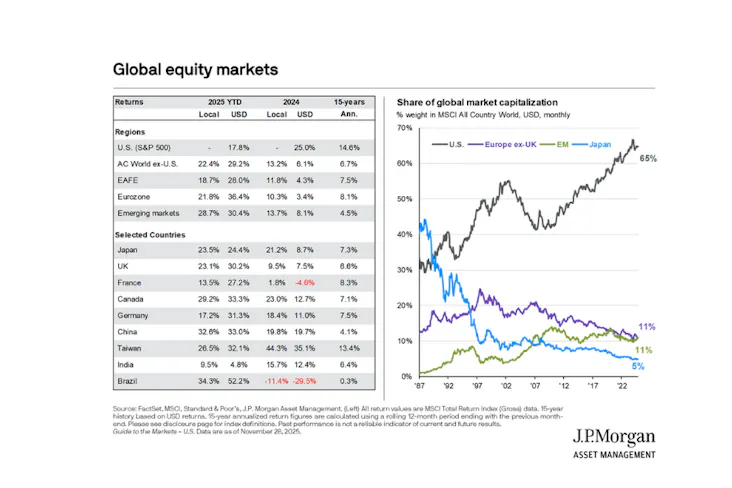
Diversifying investments across regions and markets helps reduce reliance on any single economy. Global diversification can smooth returns, reduce risk and improve resilience during periods when individual markets underperform.
09
History shows that equity markets have delivered substantial long-term growth despite wars, recessions, inflation and financial crises. Staying invested through multiple decades has historically transformed modest initial investments into significant wealth.

EQUITY MARKET PRINCIPLES
These principles are not abstract ideas. They form the foundation of every investment recommendation we make. Our role is to keep you anchored to the long term, particularly in moments when short-term noise makes it tempting to act. Discipline, diversification and time are the most reliable tools available to any investor.
01
02
03
04
05
06
07
08
09
10
11